
1990 – 1994
Breast Cancer: A Progress
Art Noise Gallery, Kingston Ontario Canada (1994)
In the Arena Chapel in Padua, Italy, a series of paintings by the great 14th-century Italian artist Giotto commemorates the events in the lives of Jesus Christ and Mary, his mother. Narration of the lives of holy men and women by means of formal, symbol-laden compositions in sequence has been used by Christian and other cultures to inspire contemplation, to bring the soul of the viewer to a state of spiritual readiness for understanding.
Breast Cancer: A Progress, though humanistic rather than religious in its perspective, is meant to follow in that great tradition. Its subject is Everywoman, who fears breast cancer like Fate; who is duly diagnosed with the disease and treated with surgery, radiation, hormones, and chemicals; who experiences the horror of recurrence and who lives yet in the hope of a miracle cure.
_________________________
1. Breast Cancer: Incidence
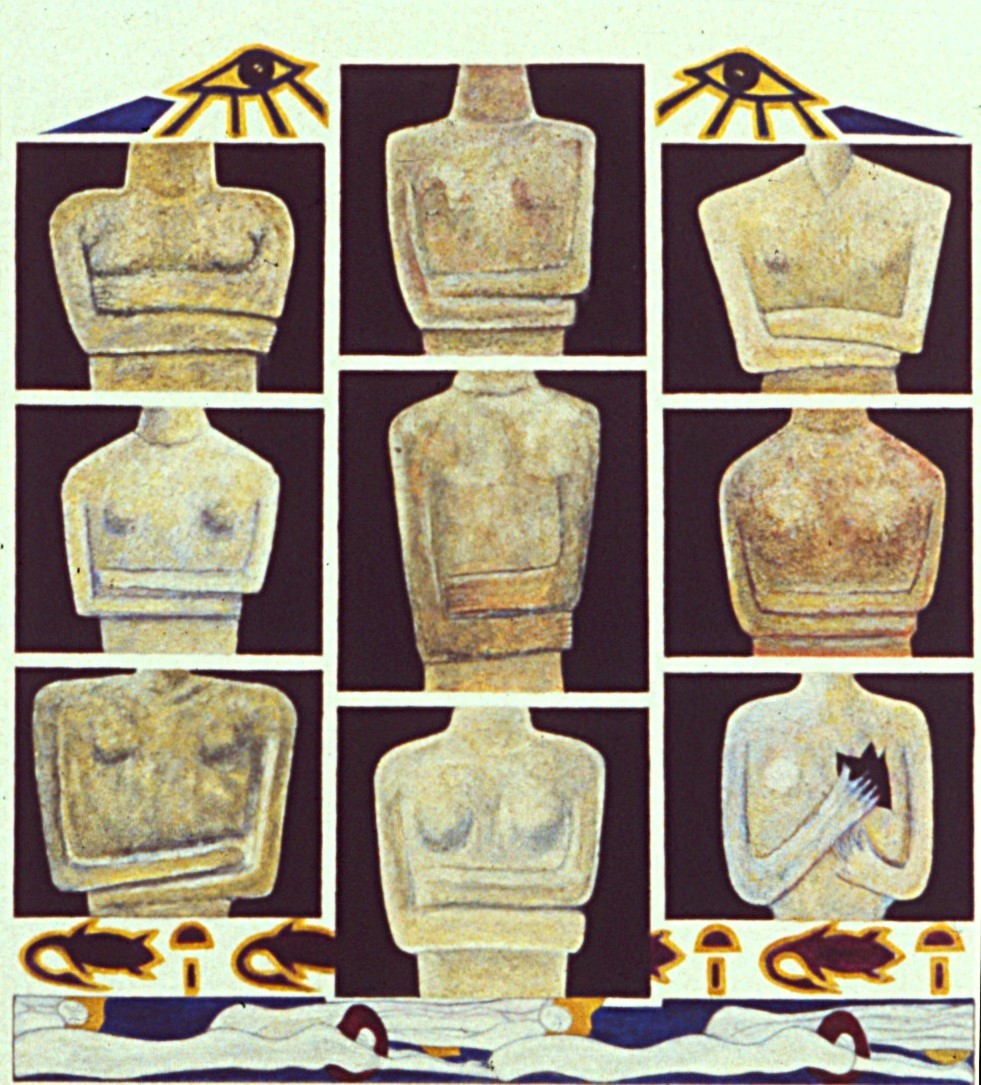
Acrylic on paper (1991)
The phrase “one in nine” summarizes for many women their fear of the rising incidence of breast cancer — in 1990, the lifetime risk for a Canadian woman of being diagnosed with breast cancer was one in nine, whereas in 1960 it was one in 20. “Lifetime risk” is a difficult concept to fully understand, and to some extent overstates the problem (earlier diagnosis makes the figures seem higher, and with some women living longer the risk over their lifetimes is consequently greater), but nonetheless breast cancer incidence is increasing, possibly due to environmental and dietary influences.
Sources/ Acknowledgements
Images: Cycladic statues (2700-2400 BC)
Floating figures: Gustav Klimt (20th century, Austria), frieze for the Beethoven exposition “The Hope for Happiness”
Eye and goose emblems: Egyptian hieroglyph for weeping, fear.
___________________________
8. Her Lap of Roses
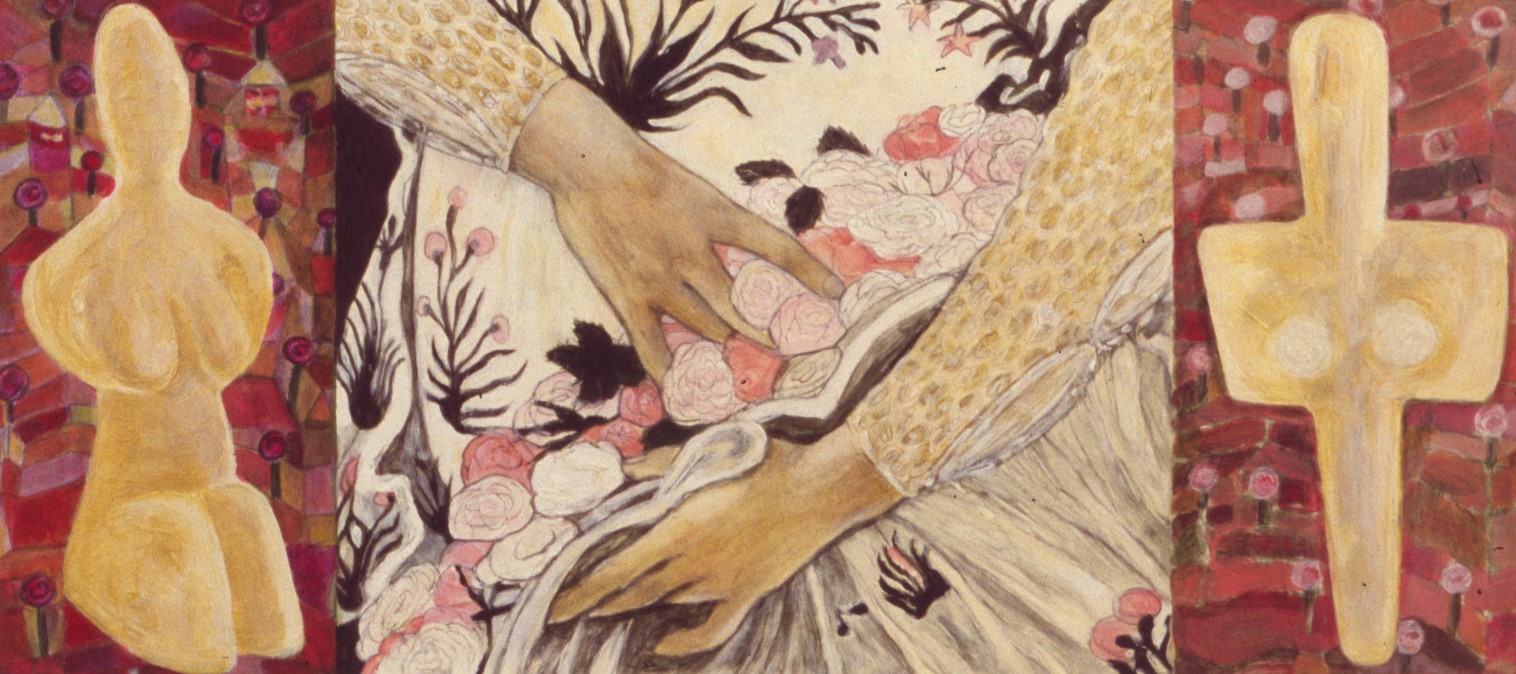
Acrylic on paper (1994)
This painting is not about breast cancer at all, but is simply a celebration of women. It was included in the series to remind us of what we are fighting for against this devastating disease.
Sources/Acknowledgements:
Centre panel: Botticelli (Italian, 15th century), Primavera (detail: lap of Flora)
Side panels, figures: Goddess figures from ancient cultures
Side panels, backgrounds: Paul Klee (Swiss, 20th century), Jardin de Roses
 npaulartworks