Take Care, and Curl

Breathe, stay
Calm for the throw
Do the draw
Play the freeze

Let the end come to you
End after end, up to ten

Chess on ice

Wait for the sign

The broom points like dawn
The sweep will extend

Throw to release

You have this
You’ve done it before
You know

The ice (Do you like it?)

The stone is smooth, the way is there
The line is clear with curl at the end, when
The rock will stop

Wait, then
Let it go

___________

Canada’s men’s and women’s curling teams will be playing for Olympic medals this weekend after many days of hard competition and brilliant play in Cortina d’Ampezzo. I look forward to cheering them on!

Rachel Homan, Tracy Fleury, Emma Miskew, Sarah Wilkes; Brad Jacobs, Marc Kennedy, Brett Gallant, Ben Hebert. This poem is for you. I wrote it yesterday.

Another poem

So far 2026 seems for me to be a time to write (a few short poems so far) and do little else except read and bear witness to events around the world and here in Canada. It has been very cold for many days. At least we have the bright white of the deep and regular snowfall. Visual art is on indefinite hold.

January

I

When at times I wonder
About the roads not taken
The woods and paths not wandered
The corners not gone round
Adventures not attempted
Star charts left in boxes

What not done or made or found
Not said or felt, seen or sensed
Conceived of or survived by
(We left the fertile fields to the foxes)

What to say to the questioning canvas, while
The white page lies and listens?

When attention is scattered like seed for the birds
Before the light fails
And the snow falls
When the will quails and cries, the fortitude craters

Or is this meditation in fact
The still point of vexation, as in
All shall be well and all manner of thing
Shall be well

The sloth crosses its arms, decides
To think about it later

II

One gloved hand holds the other
Another patient has left the room
The rest of us stare at the ceiling

The snow plow has gone by
The driveway now is blocked

Lean forward for the public service announcement:
It is seconds away from midnight
Do you know where your children are?

DisTime, DisPlace

Now is the winter of our discontent
Here is a place of disaffection

Dis – prefix indicating negation, reversal, removal, separation, expulsion
Take it away…

Empower, enchant,
Integrate, engage;
Favour, grace, advantage, affection,
Place, pose, play,
May; patch
Dispel, miss, pose, own,
Infect, locate, regard,
Appoint; proportionate,
Courteous, quiet;
Lodge, charge, solve,
Credit, prove;
Jointed, obedient, oriented,
Contented, reputable,
Spirited, abled;
Abuse, agree, allow, avow,
Appear, entangle,
Connect, count, continue,
Comfort, cover,
Embody, arm, band, bar.

Co; criminate, cover, combobulate,
Rupt, tort, turb, tract,
Semble, seminate, cern;
Solute, crete;
Inter, member, embowel,
Figure; temper,
Parity, repute;
Tribute.

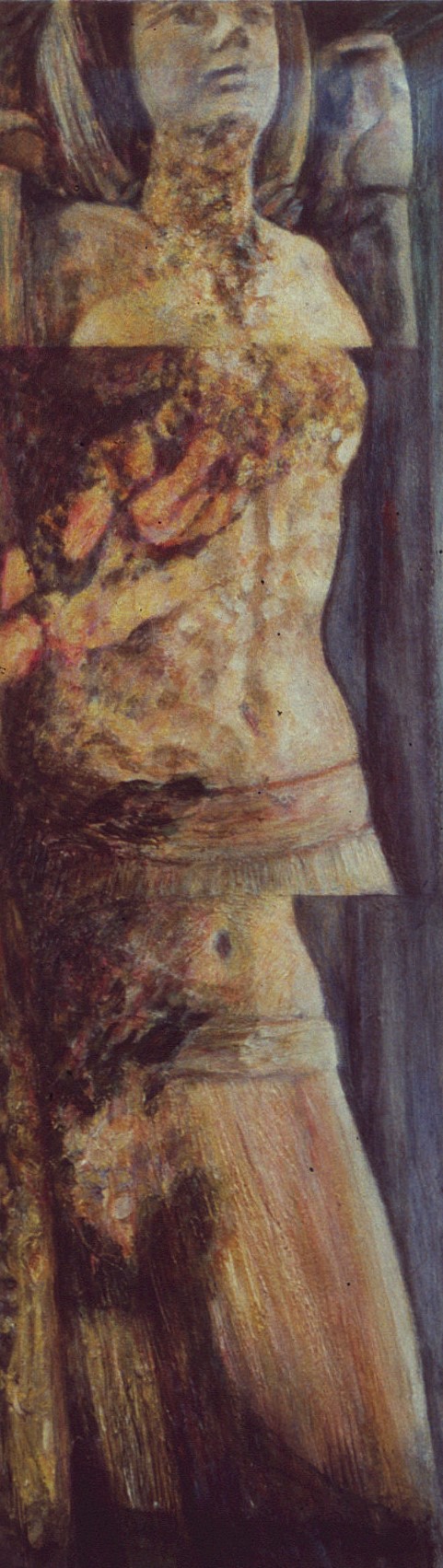
Breast Cancer: Relapse

Acrylic on paper (1994)

Despite advances in treatments for breast cancer, many women are horrified to find that their disease returns, sometimes as an ulcerating wound on their chests. The woman in the painting is anguished at the betrayal of her body; daily, she must endure the horror of cleaning and bandaging her weeping sores.

Sources/ Acknowledgements

Figure: photograph by the artist of an Egyptian statue in the British Museum

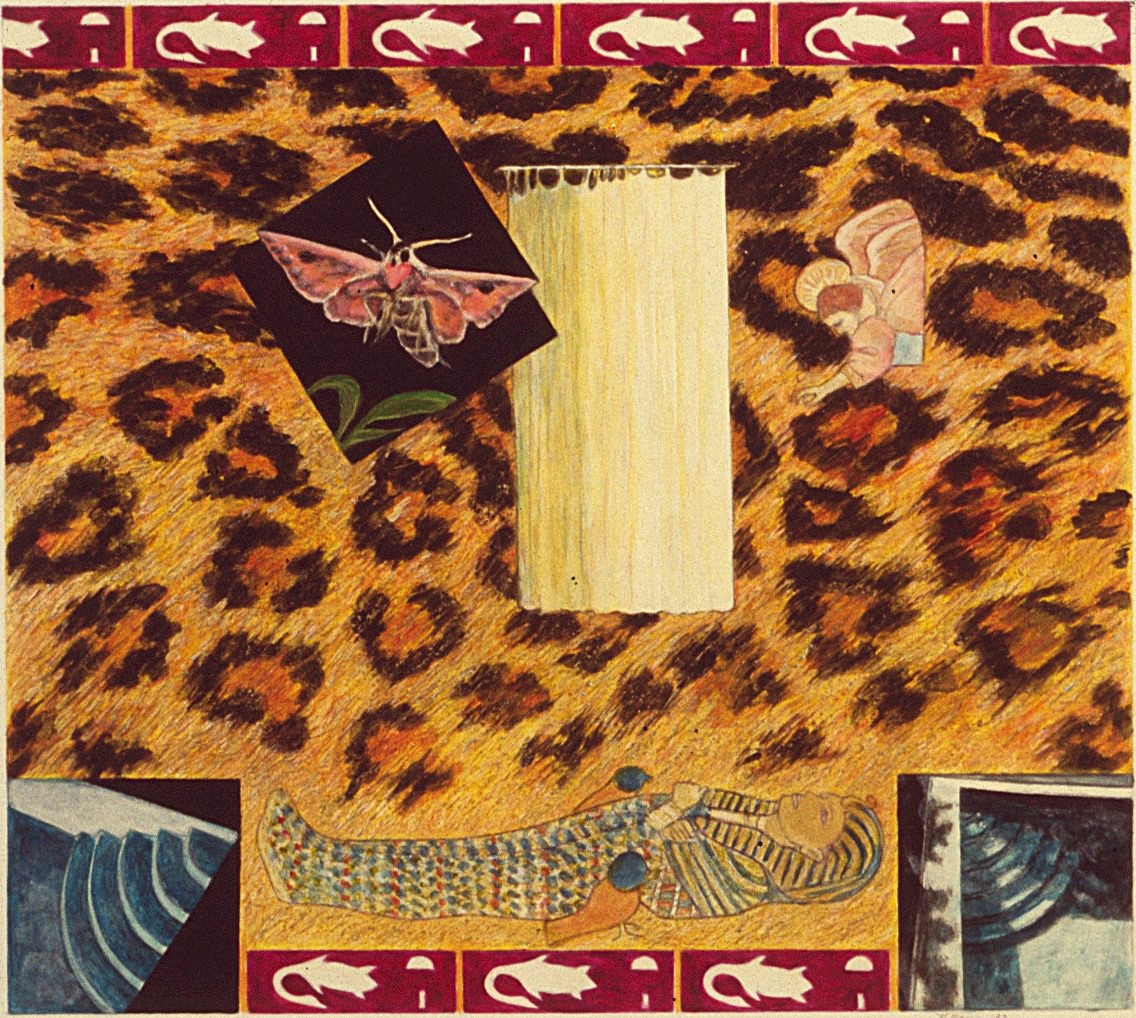
Breast Cancer: Treatment (I)

Acrylic on paper (1994)

Size (not documented, work now in private collection)

Another in my series Breast Cancer: A Progress. This is what I wrote in 1994:

“Treatment for breast cancer is for many women a nightmare. They feel powerless, dependent on the good will and expertise of the medical profession. Surgery and radiotherapy are the methods used to eradicate the “primary” cancer (the breast lump itself). While undergoing both kinds of treatments, the woman is necessarily immobilized. Removal of the cancerous mass by the surgical knife is at least easily comprehensible; radiotherapy however is mysterious and frightening, for the woman must descend below ground level where the powerful and dangerous machines are kept in thick-walled vaults.

Sources/Acknowledgements:

Recumbent figure: Model/coffin of Tutankhamen, flanked by falcon and human-headed bird (Egyptian, 14th century BC)

Angel at the window, white curtain: Giotto (Italy, 14th century), “Vision of Anna”

Moth: Stephen Dalton, photograph of Lepidoptera (Spurge Hawk, sphinx) in Borne on the Wind: The Extraordinary World of Insects in Flight

Leopard fur: Robert Vavra, photograph in I Love Nature More

Goose emblem: Egyptian hieroglyph for fear

Stairs: David Hockney, preparatory Polaroid photographs for “Paper Pools” series”

Her Lap of Roses

Acrylic on paper (1994)

Size (not documented, work now in private collection)

This painting was included in my series Breast Cancer: A Progress, though it is not about breast cancer at all but is simply a celebration of women. As I wrote at the time, it was included in the series to remind us of what we are fighting for against this devastating disease.

I provided the following background information for the show at Art Noise Gallery, Kingston, 1994.

Sources/Acknowledgements:

Centre panel: Botticelli (Italian, 15th century), Primavera (detail: lap of Flora)

Side panels, figures: Goddess figures from ancient cultures

Side panels, backgrounds: Paul Klee (Swiss, 20th century), Jardin de Roses

One in Nine

Acrylic on paper (1993)

In the early 1990s I created a series of eight paintings, exhibited in 1994 at the Art Noise Gallery in Kingston. Breast Cancer: A Progress was meant to follow in the tradition of the formal, symbol-laden compositions in sequence used by Christian and other cultures to inspire contemplation, to bring the soul of the viewer to a state of spiritual readiness for understanding. I was particularly inspired by Giotto’s commemoration of the events in the lives of Jesus Christ and Mary, his mother.

To view the full series of paintings, see my new page, Breast Cancer: A Progress (currently under construction). I apologize for the quality of the image; I am working from old slides and negatives of these works, as the originals were donated after the exhibit to the Canadian Cancer Society. My understanding is that they were given by the CCS to some of their major donors for their private collections (see CV page, Collections).

This painting is the first in the sequence, titled Breast Cancer: Incidence. The phrase “one in nine” encapsulated in 1990 for many women their fear of the rising incidence of breast cancer. See my new page Part II: 1990-2010 for an explanatory paragraph, including Sources and Acknowledgements, I wrote about this piece back in 1992.