
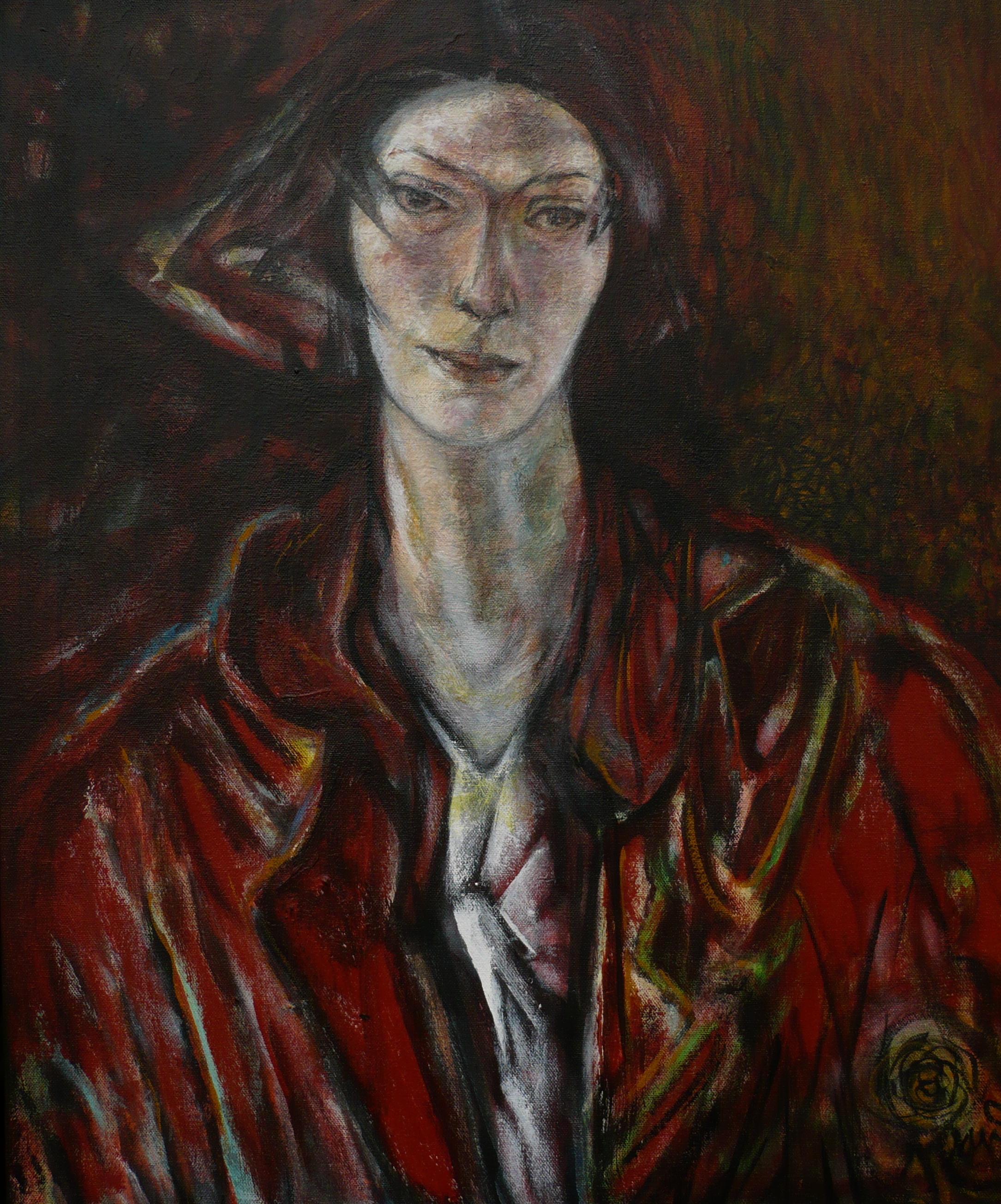
Acrylic on canvas, 2015
Size: h 61 cm x w 50.8 cm (same size as the original Vera, by FH Varley, 1931)
Vera Olivia Weatherbie was born in Vancouver, studied at the Royal Academy in London, and was one of the first graduates of the Vancouver School of Decorative and Applied Arts in 1929. She won many awards for her artwork during her association with the VSDAA and afterward. She exhibited regularly and taught drawing, painting, and composition at the BC College of Arts, an institution founded by FH Varley and Jock Macdonald in 1933.
Vera Weatherbie’s portrait of her VSDAA teacher FH Varley (of the Group of Seven) was exhibited in 1931 at the National Gallery of Canada (http://projects.vanartgallery.bc.ca/publications/75years/exhibitions/3/1/artist/55/86.178). It caused a sensation. Blodwin Davies wrote in the Toronto Star Weekly that Weatherbie had “invaded the world of metaphysics in a daring effort to commit to paint the immaterial qualities of personality.”
Later that year, Varley painted what is arguably the most famous portrait painting in Canada, Vera. http://www.gallery.ca/en/see/collections/artwork.php?mkey=7516
Strangely, Vera Weatherbie (at least, outside of her native British Columbia) is known more as a subject and muse for artists, than as an artist in her own right. Her work received a revival of interest in the 1980s, 1990s, and recently in the early years of this century. But it is Varley’s compelling portrait of her — sensual, aggressive, spiritual (see the discussion of Varley’s grandson Christopher in F.H. Varley, #6 in the Collection: Artistes Canadiens, ed. Dennis Reid) — that is apparently her primary legacy in the art world.
My painting imagines Vera later, after the intense years of creativity in the 1920s and 30s, beyond her time as model and muse for Varley and the photographer John Vanderpant, past her marriage to Harold Mortimer Lamb. She remains sensual, aggressive, spiritual.




 npaulartworks